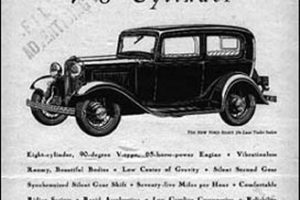


The term 1932 Ford may refer to three models of automobile produced by Ford Motors between 1932 and 1934: the Model B, the Model 18, and the Model 40. These succeeded the Model A. The Model B had an updated four-cylinder engine and was available from 1932 to 1934. The V8 was available in the Model 18 in 1932, and in the Model 40 in 1933 & 1934. The 18 was the first Ford fitted with the flathead V-8. The company also replaced the Model AA truck with the Model BB, available with either the four- or eight-cylinder engine.
The three car models were replaced by the streamlined Model 48 in 1935
Technical
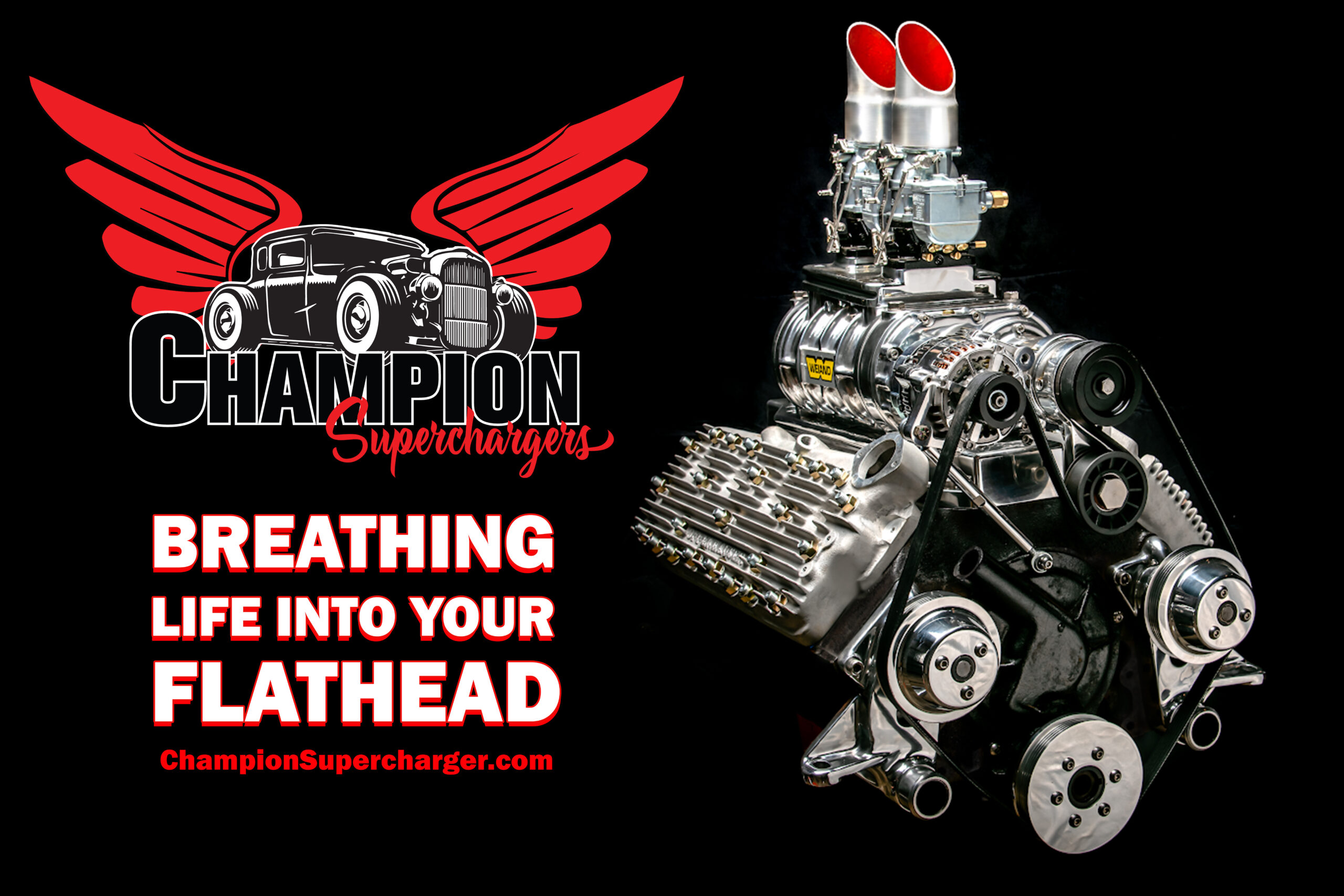
Rather than just updating the Model A, Ford launched a completely new vehicle for 1932. The V8 was marketed as the Model 18 in its initial year, but was commonly known as the Ford V‑8. It had the new flathead V8 engine. The Model 18 was the first low-priced, mass-marketed car to have a V8 engine, an important milestone in the American automotive industry. The 221 cu in (3.6 L) V8 was rated at 65 horsepower (48 kW; 66 PS), but power increased significantly with improvements to the carburetor and ignition in succeeding years. The V8 was more popular than the four-cylinder, which was essentially a variant of the Model A engine with improvements to balancing and lubrication.
Model B was derived with as few technical changes as possible to keep cost low. Other than the engine, and badging on headlamp support bar (later: grille) and hub caps, it was virtually indistinguishable from the V-8. Its intention was to be a price leader, and as it offered more than the popular Model A, this should have been a winning formula. In fact, the new and only slightly more expensive V-8 stole the show, and finally made it obsolete. The V8 engine was previously exclusive to Lincoln products, which in 1932 switched to V12 engines only.
Although there is a certain visual similarity with the predecessor Model A, the car was new. While the Model A has a simple frame with two straight longitudinal members, the new car got a longer wheelbase, and an outward curved, double-dropped chassis. In both models the fuel tank is relocated from the cowl as in Model A and late Model T, where its back formed the dash, to the lower rear of the car, as is typical in modern vehicles; thus requiring Ford to include an engine-driven fuel pump rather than rely on gravity feed. While the V8 was developed from scratch, the B just had an improved four-cylinder Model A engine of 201 cu in (3.3 L) displacement producing 50 hp (37 kW; 51 PS).
1932

When Ford introduced the Model A in late 1927, there were several competitors also offering four-cylinder cars, among them Chevrolet, Dodge, Durant, and Willys. That changed within a few years, soon leaving the new Plymouth the sole major make in the Ford’s price class with a four.
Although sharing a common platform, Model Bs and Model 18s came not only in Standard and Deluxe trim, they were available in a large variety of body styles. Some of them, such as the commercial cars described below, were only available as Standards, and a few other came only in Deluxe trim. There were two-door roadster, two-door cabriolet, four-door phaeton, two and four-door sedans, four-door “woodie” station wagon, two-door convertible sedan, panel and sedan deliveries, five-window coupe, a sport coupe (stationary soft-top), the three-window Deluxe Coupe, and pickup. The wooden panels were manufactured at the Ford Iron Mountain Plant in the Michigan Upper Peninsula from Ford owned lumber. One of the more well known and popular models was the two-door Victoria, which was largely designed by Edsel Ford. It was a smaller version of the Lincoln Victoria coupe, built on the Lincoln K-series chassis with a V8 engine; by 1933 Lincoln no longer used a V8 and only offered the V12, with the V8 now exclusive to Ford branded vehicles.
Prices ranged from US$495 ($10,617 in 2022 dollars) for the roadster, $490 for the coupes ($10,510 in 2022 dollars), and $650 for the convertible sedan ($13,942 in 2022 dollars). Production totals numbered from 12,597 for the roadster to 124,101 for the two-door sedan. Ford sold 298,647 V8-powered 18s in 1932, and except for the fact Ford could not keep up with V8 demand, the essentially identical four-cylinder B would have been a sales disaster: dealers switched customers to them from the V8, and even then sold only 133,539, in part because the V8 cost just US$10 more ($214 in 2022 dollars).
The B was discontinued because buyers disliked four-cylinder models in general, and because of the huge success of the V8, not for being an inferior car. In fact, it persisted a little longer in Europe, where in many countries the tax system heavily favored smaller-displacement engines.
Today, the 1932 Model B, although always a little bit in the shadow of the V8, is a highly collectible car and people will pay thousands of dollars to restore one to original specification, which is ironic, as they were once cheap “throwaway” cars popular with hot rodders who would tear them apart and use them as the basis for a “build”, which is partly why it is so hard to find an unaltered specimen today.
All 1932 Fords—V8-8s and Model Bs—came with black fenders, wire wheels, and a rear-mounted spare wheel (side mounted on cars equipped with a tail gate). Options included single or twin side mounts, luggage rack, clock, interior and exterior mirrors, and choice of leather or Broadcloth (closed cars) interior material.
Paints were Pyroxylin lacquer.
One special type was the flathead V8-engined B 400 body style, of which only 842 were made. This was a two-door cabrio coach, a convertible coupe with fixed side window frames. Most of them were exported for overseas markets or ambassador use. Since sales were poor it was soon discontinued, becoming the rarest of 1932 Fords. The B 400 body style was replaced by a more expensive full convertible.
Standard and Deluxe trim

The B shared frame, bodies, and even most of the trim with the eight-cylinder car. The only technical difference was the use of the slightly reworked Model A engine, thus the designation B. Most body styles were available as Standard or Deluxe variants with either engine offered as an option. Customers could get a Deluxe version of the 1932 Model B in three-window coupe (which only came in Deluxe model), roadster, phaeton, Tudor and Fordor as well.
Standard trim meant black front window frame, black wire wheels (color optional), black horn (chrome-plated optional), single tail light (second optional), painted dash, position lights integrated in the head lamps (Deluxe cowl lamps optional), and less expensive interiors