
1932-1936 Ford Clutches
CLUTCH
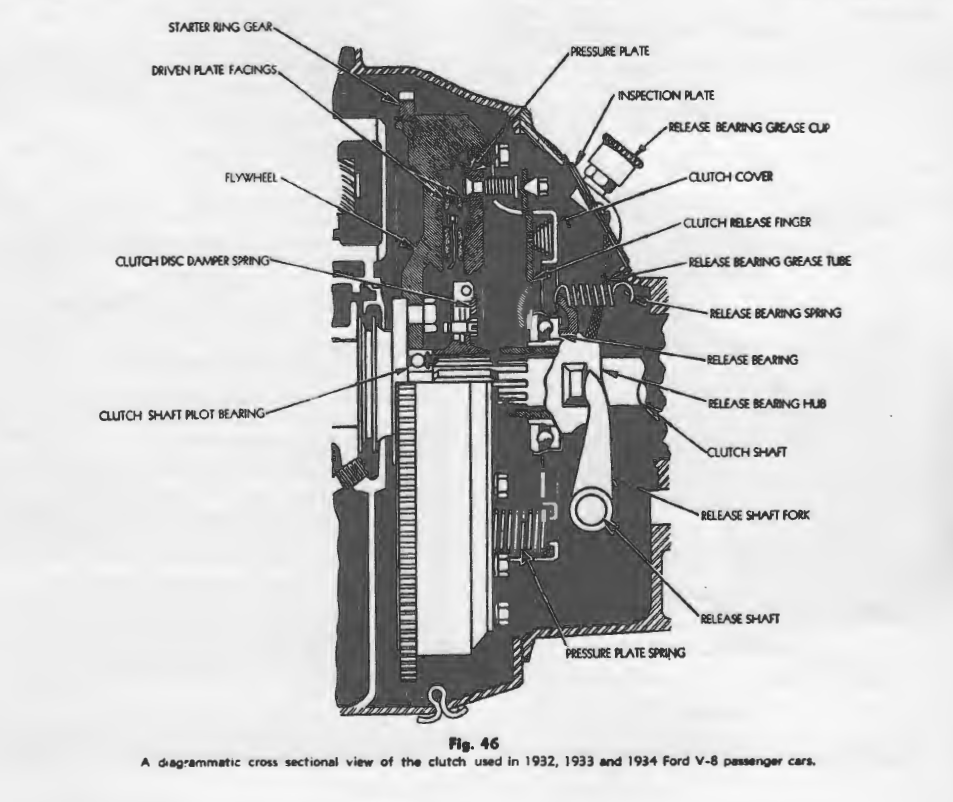
1932, 1933 and 1934 Ford V-8 passenger cars were equipped with Long type, single plate, dry disc clutches with spring type damper in the driven plate. A diagrammatic cross section of this clutch is shown in Fig. 46.
1933 and 1934 truck models were equipped with the same type clutch as that for passenger cars except that the driven plate is larger in the clutches used in the trucks.
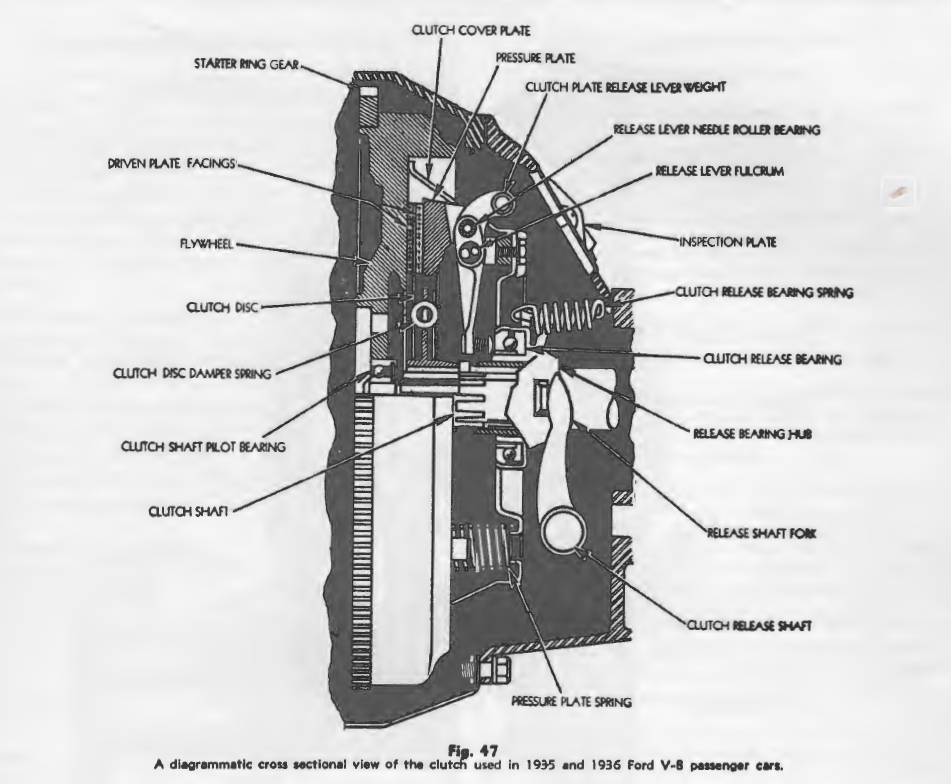
1935 and 1938 Ford V-8 passenger can were equipped with Long centrifugal type, single plate, disc clutch with spring type damper in the hub of the driven plate. The centrifugal type dutch has three weights which increase the pressure on the driven plate by means of centrifugal force as the speed of the engine is increased. This type of design makes it possible to reduce the pedal pressure necessary to disengage the clutch at engine speeds below 750 r.p.m. A diagrammatic cross section of this tYP8 of clutch is shown in Fig. 47.
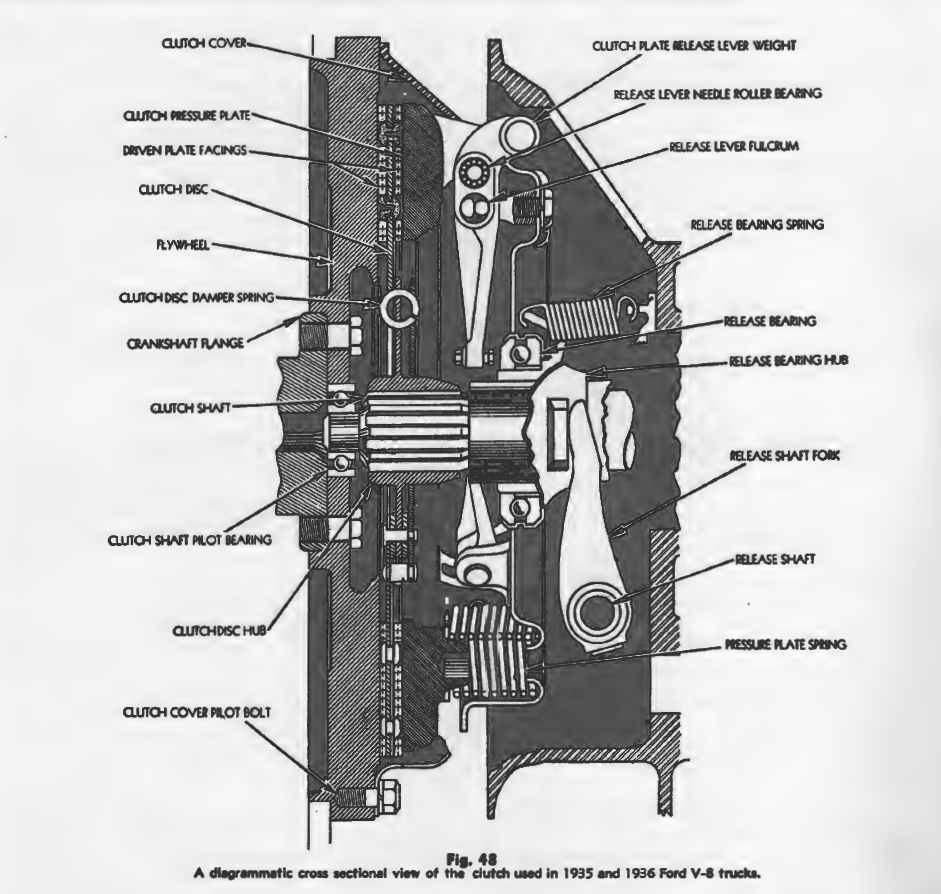
1935 and 1936 truck model A used the same type of clutch as that for passenger cars of the same years except that the driven plate is larger and nine pressure springs are used in the cover plate assembly, while only six are used in the passenger cars. A diagrammatic cross section view of the clutch used in trucks is shown in Fig. 48.
Interchangeable Clutch Parts:-The clutch driven plate tor 1935 and 1936 models can be used in the earlier type clutch but the earlier tYP8 driven plate cannot be used in the 1935 and 1936 clutch because of interference of
the clutch fingers when the clutch is released.
Clutch Adjustment
The clutch pedal free travel or throwout bearing clearance should be measured at the pedal pad. The following adjustments are for both passenger cars and trucks of the same year. For 1932, 1933 and 1934 models, ad- just the free travel of the pedal from 1″ to 11⁄2″; for all 1935 and 1936 models the free travel should be from 12″ to 2″. The increased pedal clearance for 1935 and 1936 clutches is necessary to prevent interference be- tween the throwout bearing and the clutch levers at high engine speeds when the movement of the counter- weights force the clutch levers back.
The clutch pedal travel can be changed by changing the length of the release arm rod. To do this, remove the pin from the clevis on the end of the release arm rod and turn the clevis on the rod. Shorten the rod to in- crease the free travel and lengthen it to decrease the travel.
CAUTION: The clearance for the centrifugal type clutch must be adjusted with the engine stopped.
How to Remove the Clutch
Remove the transmission. Mark the cover plate and flywheel so that the cover plate can be installed in the same position on the flywheel. Take the six cover plate bolts loose from the flywheel and the clutch assembly can then be removed.
CAUTION: The bolts used to hold the cover plate to the flywheel are specially designed to serve as pilots for the pressure plate assembly and should not be re- placed with any other type of bolt. When removing or replacing the cover plate, loosen or tighten the pilot bolts alternately about one turn at a time. This will avoid springing or warping the plate.
Clutch Noise
Noises originating in other parts of the car may readily be mistaken for clutch noises unless the inspection is made with the floor boards and clutch inspection cover removed. A clattering or chattering noise may be caused by a loose fit between the hub of the driven plate and the splines on the transmission main drive shaft when the clutch is disengaged or when the car coasting between the speeds of 20 and 30 miles per hour. A noise from this source can be removed by = stalling a new driven plate that fits the splines of the main drive shaft snugly or if a snug fit cannot be obtained with a new plate, install a new shaft also.